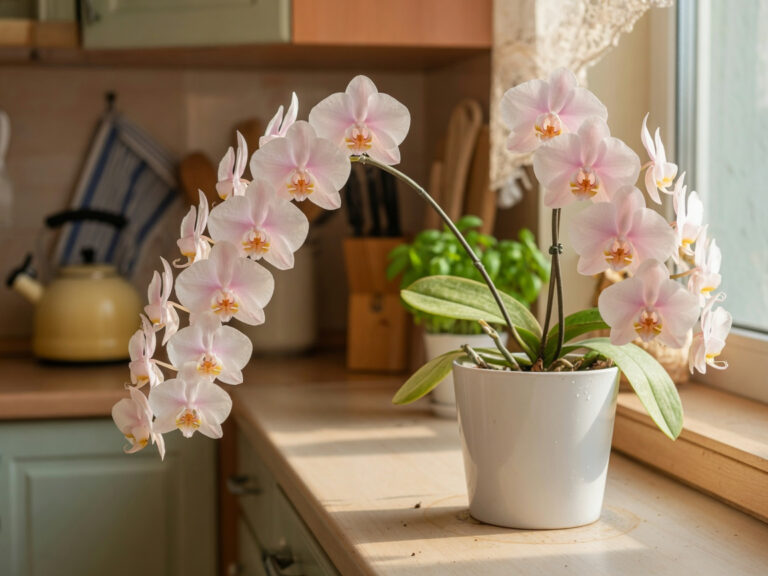
Cut orchids can stay vibrant for one to three weeks in a vase when you give them the right conditions from the start. The fundamentals are simple: pick buds that are still closed or only half-open, cut stems at a 45-degree angle, use cool clean water, and refresh it every two to three days. Get those steps right and even delicate blooms will outlast most people’s expectations.
Some of the links in this article may be affiliate links. If you make a purchase through these links, we may earn a small commission at no extra cost to you. Thank you.
Quick Summary
- Freshly cut orchids last 1–3 weeks in water but only 1–2 days in arrangements without water
- Always choose closed or half-opened buds — fully bloomed flowers fade fastest
- A 45-degree stem cut maximises water absorption and slows bacterial build-up
- Changing the water every 2–3 days and keeping orchids away from heat and ripening fruit are the easiest ways to add days to their display
What Shelf Life Should You Realistically Expect From Cut Orchids?
The short answer: anywhere from a few days to three weeks, depending on species, bloom stage, and ongoing care. Orchids placed in a clean vase of water typically last one to three weeks. Orchids in a corsage or button-hole without any water, by contrast, have a shelf life of just one to two days — a striking difference that shows how much hydration matters from the very moment the stem is cut.
Species plays a notable role. Moth orchids (Phalaenopsis) and Dancing Lady orchids (Oncidium) are renowned for their long vase life, often reaching the upper end of the one-to-three-week window. Slipper orchids (Paphiopedilum) are impressively durable too. More delicate varieties, such as some Cattleyas, may fade faster. If you want to approach your flower choices with deeper knowledge, exploring the fascinating diversity of orchid types, habitats, and characteristics is an excellent place to start before making your selection.
The stage of bloom at cutting matters just as much as species. A stem where every flower is already wide open is already at its peak — it can only decline from there. A stem carrying several closed or half-opened buds, however, will continue to develop in the vase, delivering a rolling display of fresh blooms that extends the overall arrangement life considerably. Bud selection at the point of purchase or harvest accounts for a large proportion of eventual vase life — often more than preservative treatments applied afterwards.
Which Orchid Species Last Longest as Cut Flowers?
Not all orchids age at the same pace once cut. Knowing which species to reach for gives you a head start on longevity. Here are the standout performers in 2026:
- Moth Orchid (Phalaenopsis): The most widely available cut orchid and one of the longest-lasting. Multiple buds on a single arching stem open in sequence over two to three weeks, giving exceptional value from a single stem.
- Dancing Lady Orchid (Oncidium): Dozens of small, bright flowers on branching stems. Individual blooms are shorter-lived, but the sheer number keeps arrangements looking full for weeks.
- Slipper Orchid (Paphiopedilum): A single dramatic bloom per stem, but it holds its form exceptionally well — often two weeks or more with attentive care.
- Cymbidium: Large, waxy blooms that are naturally robust. Frequently used in bridal work because they hold up well even out of water for short periods, making them one of the most forgiving options for event arrangements.
- Dendrobium: Popular in floral markets for their long spikes and impressive staying power. A well-conditioned Dendrobium spike can last close to three weeks in a clean vase.
If you grow your own orchids and want the best possible blooms available for cutting, understanding the key factors behind orchid blooming and multiple spike production will help you time your harvests for peak vitality and give you the strongest possible starting material.
How Do You Select the Best Orchid Stems for Cutting?
At the florist or in your own garden, the selection stage is where longevity is largely decided. Here is what to look for before you buy or cut:
- Choose closed or half-opened buds. Avoid stems where every bloom is already fully open. Closed buds give you the most development time remaining, translating directly into more days of display.
- Check the stem ends. If stems have been sitting out of water for any length of time, the cut end may have begun to seal. These stems need an immediate re-cut before arranging — otherwise they cannot drink efficiently no matter how well you care for them.
- Inspect the foliage. Yellowing, wilting, or mushy leaves signal a stressed plant. Healthy stems come from healthy plants, and stress in the donor plant shortens cut-stem life significantly.
- Look for pests or physical damage. Any sign of pest activity, mould, or bruising on the blooms will accelerate decline once the stem is in the vase.
- Consider stem length. Water travels a shorter distance up a shorter stem, so blooms receive hydration more efficiently. A shorter stem — while less dramatic in an arrangement — can actually outlast a long one by a meaningful margin.
The condition of a stem at the point of selection has a major bearing on its eventual vase life. No preservative routine fully compensates for a poorly chosen starting bloom, which is why this step deserves as much attention as everything that follows.
What Is the Correct Technique for Cutting Orchid Stems?
The angle and timing of your cut directly determines how well the stem draws water. A flat, blunt cut can rest flush against the vase base and limit uptake. A 45-degree angled cut avoids this entirely and increases the exposed surface area, giving the stem its best possible access to hydration.
Follow these steps each time you cut or re-cut a stem:
- Use clean, sharp scissors or a floral knife. Blunt tools crush vascular tissue rather than slicing cleanly through it. Crushed tissue cannot absorb water properly, however much care you apply afterwards.
- Cut underwater if possible. Submerging the stem end in a bowl of water as you cut prevents an air bubble from entering the newly opened vessel. Air locks are a leading cause of premature wilting in cut flowers, and this single step eliminates that risk entirely.
- Angle the cut at 45 degrees. This enlarges the drinking surface and keeps the cut end clear of the vase base so water can flow freely into the stem at all times.
- Remove any foliage that would sit below the waterline. Submerged leaves decompose quickly, feeding bacterial growth and clouding the water within hours of arrangement.
- Re-cut the stem every 2–3 days. Each time you change the water, trim a thin slice from the base at the same 45-degree angle to expose a fresh surface. This habit alone can add several days to vase life.
- Sterilise your tools between uses. A quick wipe with rubbing alcohol is sufficient. Bacteria transferred from tool to stem are a surprisingly common route of contamination that is entirely avoidable.
How Should You Arrange Cut Orchids in a Vase?
Arranging orchids in a vase is genuinely enjoyable — they suit everything from a minimalist single-stem display to an elaborate multi-bloom centrepiece. A few practical decisions at the arranging stage support both the aesthetic you are after and the longevity of the blooms themselves.
| Arrangement Choice | What It Does for Longevity |
|---|---|
| Tall, narrow-necked vase | Supports stems upright without bending; reduces physical stress on delicate tissue |
| Wide bowl with stones or floral foam | Anchors stems securely without overcrowding or submerging excess foliage |
| Minimal foliage in the arrangement | Reduces moisture loss through transpiration; fewer leaves competing for water |
| Curly willow or ornamental branches | Add visual fullness without drawing on the water supply; pair beautifully with orchid spikes |
| Two or three stems maximum per vase | Clean, modern aesthetic and less competition for nutrients in a shared water source |
Position the vase in a spot that receives bright, indirect light. Direct sun heats the water, accelerating bacterial growth and causing blooms to wilt prematurely. If you are unsure about the right light balance for orchids more broadly, the complete guide to ideal orchid lighting covers the topic in depth and applies equally well to both cut stems and potted specimens.

What Water and Additives Help Cut Orchids Stay Fresh Longer?
Water quality is non-negotiable. Tap water in most of the UK is perfectly suitable for cut orchids — it contains enough dissolved minerals to support the flowers without encouraging excessive algae. A few simple adjustments, however, make a genuinely noticeable difference to vase life and are well worth building into your routine.
- Always use cool water, not warm. Cool water slows bacterial growth and keeps stem tissue firm. Warm water does the opposite and can accelerate decomposition of the stem ends within hours of arranging.
- Add one drop of chlorine bleach per litre. Standard household bleach at this concentration effectively inhibits bacterial growth without harming the flowers. It is one of the most cost-effective preservation methods available and costs almost nothing to implement.
- Try a commercial floral preservative sachet. These typically combine a sugar source for nutrition, a biocide for bacterial control, and an acidifier to improve water uptake. Used consistently, they can extend vase life meaningfully beyond what plain water alone achieves.
- Avoid sugar alone. Sugar without a biocide feeds bacteria as readily as it feeds the flowers, often resulting in a net negative effect on vase life. If you use it, always pair it with the bleach method above.
- Rice water is sometimes discussed as a natural alternative, though results vary considerably by orchid type and water quality. For a thorough look at the evidence, the article on the pros and cons of using rice water for orchids weighs up what actually works and what is largely myth.
Change the water completely every two to three days — do not simply top it up. Empty the vase, give it a quick rinse, and refill with fresh cool water. Bacteria multiply rapidly in stale vase water, and even a clear-looking vase can harbour enough microbial activity to block stem vessels and shorten vase life by several days.
How Does Temperature Affect the Longevity of Cut Orchids?
Temperature is one of the biggest factors in cut orchid lifespan — and one of the most often overlooked. Orchids are tropical plants, but that does not mean they perform best in warm rooms once cut. Cooler ambient temperatures slow the cellular processes that drive ageing in cut flower tissue, effectively buying you more days per arrangement.
Temperature has a direct effect on how quickly cut flower tissue ages. For cut orchids, the ideal range sits between 16°C and 21°C (60°F to 70°F). Below 10°C the blooms risk cold damage; above 24°C, deterioration accelerates sharply and no amount of water management can fully compensate.
- Keep cut orchids well away from radiators, heat vents, and south-facing windowsills during summer months
- Avoid placing arrangements near heat-generating appliances such as televisions or computers
- Ethylene gas — released by ripening fruit, particularly bananas and apples — accelerates petal drop at any temperature; keep orchids away from the fruit bowl entirely
- A cool hallway or north-facing room is ideal for extending a display between occasions or events
- Moving arrangements to a cooler room overnight, where practical, can meaningfully add to vase life over a seven-to-ten-day period
What Everyday Mistakes Shorten Cut Orchid Life?
Even experienced gardeners fall into habits that quietly reduce vase life. These are the most common culprits — and the ones most worth eliminating from your routine:
- Not re-cutting the stem before placing in water. If a stem was cut even an hour ago, the vessels will have begun to seal. A fresh angled cut at the base is essential before arranging — without it, the stem cannot drink regardless of how clean the water is.
- Leaving foliage submerged in the vase. Any leaf or bud below the waterline will decompose, clouding the water and releasing bacteria within 24 hours of arrangement.
- Topping up instead of changing the water. Topping up dilutes bacteria slightly but does not reset water quality. A full change every two to three days is the correct approach.
- Using warm or hot water. It may feel kinder to the flowers but actively encourages the bacteria you are trying to suppress.
- Placing the vase near ripening fruit. The ethylene released by a single banana is enough to visibly shorten an orchid arrangement within a day or two — a surprisingly powerful effect from something so easy to avoid.
- Choosing fully opened blooms. Beautiful as they look in the shop, fully open blooms are at their peak. They have fewer days ahead of them than most buyers realise.
- Neglecting the vase itself. A vase carrying residue from a previous arrangement introduces bacteria from the very start of the new display. Wash vases thoroughly between uses.
How Do You Build a Simple Daily Care Routine for Cut Orchids?
Consistency beats intensive intervention. A short, regular care routine is far more effective than occasional dramatic measures. Here is a practical schedule that takes less than five minutes every few days and reliably delivers two to three weeks of display from quality stems:
- Day 1 — Arranging day: Make a fresh 45-degree cut on each stem, remove all below-waterline foliage, fill the vase with cool water and one drop of bleach per litre, and position the arrangement away from heat and direct sun.
- Days 2–3 — Monitor: Check water level and observe whether any blooms are showing early signs of stress. Do not top up yet — observe only.
- Day 3 — First water change: Empty and rinse the vase. Re-cut 5mm from each stem at 45 degrees. Refill with fresh cool water and a drop of bleach.
- Days 4–6 — Ongoing: Remove any spent blooms that have fully dropped or browned — leaving them in place accelerates mould across the remaining healthy flowers.
- Day 6 — Second water change: Repeat the full water change and re-cut process. A healthy arrangement should now comfortably last another week.
- Week 2 onward: Continue three-day water change cycles. Remaining buds will open in sequence, naturally extending the display without any additional effort.
For those who also grow orchids in pots, the care habits you build around cut stems often translate well to living plants too. Understanding how to encourage strong, healthy orchid root growth in your potted specimens means you will always have well-hydrated, vigorous stems ready for cutting whenever you need them.
What Does the Future of Cut Orchid Care Look Like in 2026?
The cut flower industry is investing heavily in post-harvest research, and orchids are direct beneficiaries. Several developments are shaping the way growers, florists, and home gardeners approach longevity in 2026 and the years immediately ahead:
- Nano-silver preservatives: Nano-silver compounds, long used in commercial cut-flower agriculture, are beginning to appear in consumer-grade floral products. Their antimicrobial properties are markedly stronger than bleach at equivalent concentrations and show particular promise with tropical flowers including orchids.
- Ethylene blockers: Compounds that interfere with ethylene receptors in plant tissue — used commercially in fruit storage for decades — are now being formulated for home floral use. Applied at the time of cutting, they can significantly delay petal drop in ethylene-sensitive orchid varieties without affecting colour or fragrance.
- Hydrogel conditioning: Rather than standing stems in conventional water, some commercial operations pre-condition orchid stems in hydrogel solutions that saturate the vascular tissue before arrangement. Consumer versions have arrived in UK garden centres in 2026.
- Cold-chain improvements: Retailers and florists are adopting tighter cold-chain protocols from grower to shelf. The orchids available to buy in 2026 typically arrive in better condition than those of five years ago, giving you a stronger starting point before home care begins.
If you are ready to expand beyond standard Phalaenopsis and Dendrobium, there has never been a better time to explore the full spectrum of available varieties. A beautifully curated visual guide to stunning variegated orchid varieties is an excellent starting point for finding your next favourite cut flower candidate.

Frequently Asked Questions
How often should I change the water in the vase when keeping cut orchids?
Change the water completely every two to three days — not just top it up. Empty the vase, rinse it thoroughly, and refill with fresh cool water. This resets bacterial levels and ensures the stems have clean, unobstructed water to draw from. Consistent water changes are the single most impactful ongoing habit for extending vase longevity across all orchid varieties.
Can I use warm water to keep cut orchids fresh?
No — warm water actively promotes bacterial growth, which is the primary cause of premature wilting in cut orchids. Always use cool water from the tap. The lower temperature slows both bacterial multiplication and the natural cellular ageing process in flower tissue, giving you noticeably more time before blooms begin to fade.
Is it necessary to add sugar to the water for cut orchids?
Sugar alone is not recommended. While it provides a small nutrient boost, it feeds bacteria just as readily as it feeds the flowers — often resulting in a net negative for vase life. If you want to supplement the water, use a commercial floral preservative sachet, which pairs a sugar source with a biocide. The simplest and most cost-effective alternative is one drop of standard household bleach per litre of cool water, which works reliably and costs almost nothing.
Why are my cut orchids wilting even though I change the water regularly?
The most common cause is that stem ends are not being re-cut each time the water is changed. Without a fresh 45-degree cut, the vascular vessels seal over between water changes and the stem can no longer absorb water effectively — the flowers wilt even sitting in a full, clean vase. Other causes to check in order: proximity to a radiator or heat source, ripening fruit nearby, or direct sunlight falling on the arrangement. Work through those in order and the problem resolves in the great majority of cases.
Which orchid species last the longest as cut flowers?
Moth orchids (Phalaenopsis), Dancing Lady orchids (Oncidium), and Slipper orchids (Paphiopedilum) consistently outperform most other species in vase longevity. Cymbidiums and Dendrobiums are excellent choices too. All five can approach the three-week mark with attentive care. If you are buying from a florist specifically for a long-lasting display, ask for any of these by name — they are usually stocked as standard and offer the best return on your investment.
How do I prevent bacterial growth in my orchid vase?
Three habits together give the best results: use cool rather than warm water, add one drop of household bleach per litre at each water change, and ensure no foliage sits submerged below the waterline. Additionally, change the water fully every two to three days rather than topping up, and wash the vase itself between refills — residue from the previous fill harbours bacteria from the very start of the new arrangement. Keeping the display away from direct sunlight also reduces the rate at which bacteria multiply in the water between changes.
Make Every Orchid Arrangement Last as Long as Possible
Maximising the lifespan of cut orchids is not complicated — it simply requires a handful of consistent habits applied from the moment you select the stems. Choose buds that are still developing, cut cleanly at a 45-degree angle, use cool clean water with a drop of bleach, change it every two to three days, and keep the arrangement away from heat, direct sun, and ripening fruit. Follow that routine and you will routinely achieve two to three weeks of display from varieties that most people discard within a week.
Start today: if you have cut orchids in a vase right now, check the stem ends. If they have not been freshly cut in the last two to three days, trim them now at 45 degrees, change the water, and see the difference for yourself. Small actions, applied consistently, are what transform a short-lived bunch of blooms into a long-lasting floral statement.