
Leaf mold is one of the best things you can add to your garden soil — and it costs absolutely nothing. Made from nothing but decomposed leaves, this dark, crumbly material improves soil structure, boosts moisture retention, and feeds the beneficial fungi your plants depend on. If you’re already composting, leaf mold is the natural next step that puts every fallen leaf to genuine work.
Some of the links in this article may be affiliate links. If you make a purchase through these links, we may earn a small commission at no extra cost to you. Thank you.
- Free to make: Autumn leaves are abundant and would otherwise go to landfill or waste
- Exceptional moisture retention: Well-made leaf mold holds several times its own weight in water
- Feeds beneficial soil fungi: Unlike hot compost, leaf mold is driven by fungal decomposition that builds long-term soil biology
- Ready in 6–18 months: Faster with shredding; a low-effort process that essentially looks after itself
What Is Leaf Mold and Why Should Every Gardener Make It?
Leaf mold is simply leaves that have decomposed through a cold, slow, fungal process. Unlike traditional compost — which combines green and brown materials, relies on bacterial activity, and benefits from regular turning — leaf mold uses only leaves and breaks them down over months through fungal action rather than heat. The result is a dark, crumbly, earthy-smelling material that looks and behaves like woodland floor soil, because that is essentially what it is.
The process mirrors the natural cycle on a woodland floor every autumn. Leaves fall, fungi colonise them, and over one to two years they become a spongy layer of organic matter that keeps soil moist, well-structured, and biologically active. Gardeners who make leaf mold at home are fast-tracking nature’s own soil-building system — for free, using material that most people bag up and send to the tip each November.
Understanding where leaf mold sits in the broader landscape of soil additions helps you use each one to best effect. If you’re navigating what belongs in your garden beds versus your containers, our guide to understanding the differences between potting soil and compost makes a useful companion read alongside this one.
What Are the Main Benefits of Leaf Mold for Garden Soil?
The benefits of leaf mold extend well beyond simply adding organic bulk to the soil. Horticultural research consistently shows that well-made leaf mold can improve soil water retention by up to 50% compared with untreated soil — a significant advantage during dry summers. That moisture-holding quality comes from the fungal hyphae woven through the material, which create a physical matrix that captures water between soil particles without waterlogging plant roots.
Soil structure improvement is the second major gain. In clay soils, leaf mold acts as a physical spacer between particles, reducing compaction and improving drainage. In sandy soils, it fills the gaps that cause water and nutrients to drain away too quickly. Both types end up easier to work, warmer in spring, and far more hospitable to root growth. Fallen deciduous leaves are known to contain between 50% and 80% of the minerals a tree absorbed during the growing season — much of which is available to soil life and plants as the material continues to break down.
Then there is the biological dimension. Leaf mold is rich in mycorrhizal fungi and other soil organisms that form beneficial partnerships with plant roots. A thriving fungal network in your soil effectively extends a plant’s root system, helping it access water and nutrients far beyond where roots alone could reach. Our detailed guide to nurturing beneficial microbes for sustainable soil cultivation explores this underground ecosystem in depth — and leaf mold is one of the most reliable ways to support it.
Used as a mulch, leaf mold also suppresses weeds, moderates soil temperature through both summer heat and winter cold, and prevents the soil surface from crusting after rain. A 5–7cm layer over bare beds can reduce moisture evaporation by up to 70% in dry conditions, directly reducing how often you need to water established plants and borders.
| Property | Leaf Mold | Standard Garden Compost |
|---|---|---|
| Moisture retention | Excellent — holds several times its own weight in water | Good — improves water-holding capacity |
| Nutrient content | Low to moderate (slow, long-term release) | Higher (relatively faster release) |
| Soil structure improvement | Excellent — fungal hyphae physically improve texture | Good — adds organic bulk |
| Time to produce | 6–18 months (shredded to whole leaves) | 3–6 months (hot method) |
| Effort required | Very low — no turning needed | Moderate — benefits from regular turning |
| Best primary use | Mulch, soil conditioner, potting mix ingredient | General soil amendment, raised bed enrichment |
Which Leaves Are Best for Making Leaf Mold?
Almost any deciduous leaf will produce good leaf mold. Oak, beech, hornbeam, and lime (linden) are the most highly regarded choices — they are not overly waxy, they break down reliably, and they produce fine-textured, dark mold with excellent soil-conditioning properties. These are among the most common trees found in British hedgerows, parks, and gardens, making them easy to source in quantity each autumn without going far.
Sycamore, maple, and sweet chestnut leaves also decompose into perfectly good leaf mold, though they may take slightly longer than oak or beech. Plane tree leaves are tougher and benefit from shredding first. A mixed heap of whatever deciduous leaves you can gather will produce entirely usable leaf mold — variety in leaf type can actually enrich the biological community that develops during decomposition, giving you a more diverse final product.
A few exceptions are worth noting. Walnut leaves contain juglone, a natural compound that suppresses the growth of some plants, so the resulting mold is best used only around tolerant species. Very waxy leaves — holly, laurel, and evergreen magnolia — break down very slowly in cold conditions and are better composted in a hot heap or sent to green waste collection. Conifer needles are acidic and take two years or more to break down fully; kept separate from other leaves, they make a useful pine needle mulch for acid-loving plants, but they do not belong in a general leaf mold pile.
How Do You Make Leaf Mold at Home? (Step-by-Step Guide)
Making leaf mold requires no specialist equipment, no precise measurements, and almost no ongoing maintenance. Here is a reliable process that works for any size of garden.
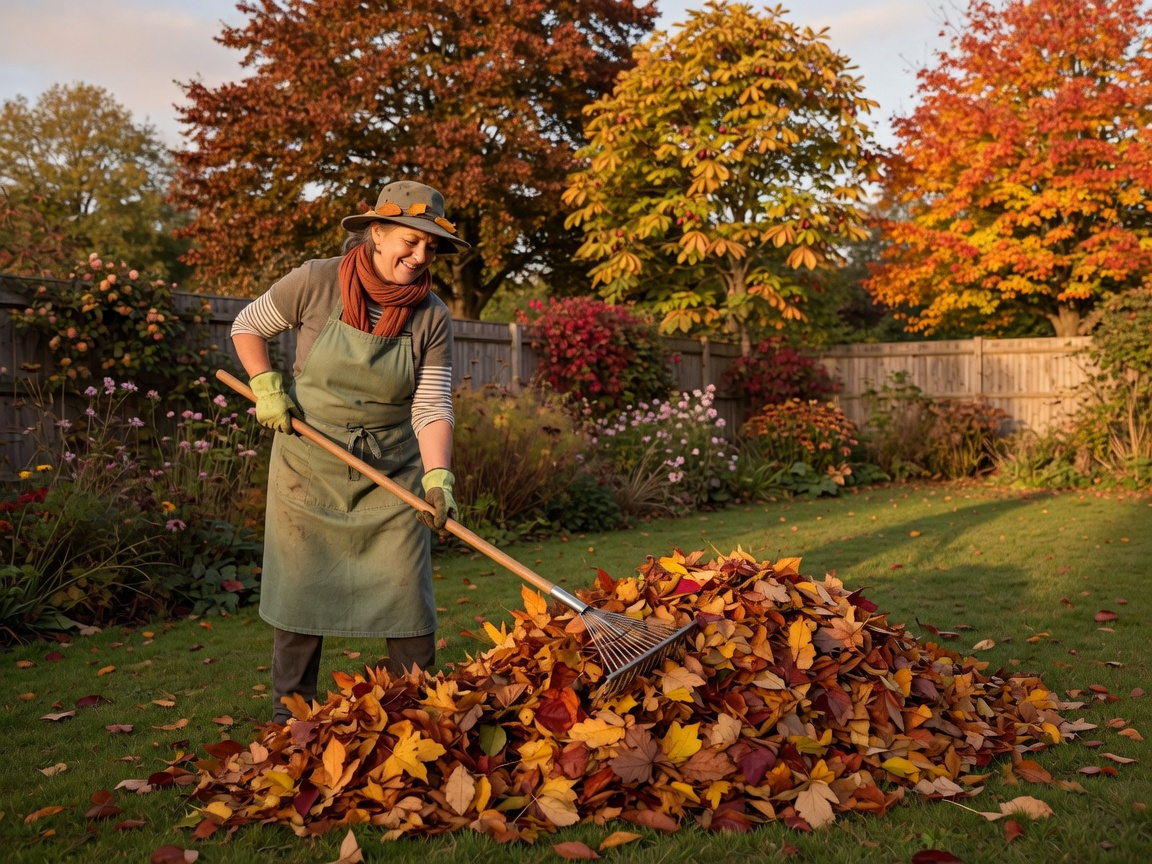
- Collect leaves in autumn. Rake or blow fallen leaves into a heap. Aim for at least 1 cubic metre — smaller piles lose moisture too quickly and decompose poorly. Gather as many leaves as you can; the greater the volume, the better and faster the results.
- Shred the leaves if possible. Run a rotary mower over a spread of leaves before gathering them, or pass them through a garden shredder. Shredded leaves break down in roughly half the time of whole leaves because they offer far more surface area for fungi to colonise — and they don’t mat together into waterproof layers.
- Choose your method: bin or bag. A simple wire mesh cage (roughly 1m × 1m × 1m) contains the pile neatly and allows air to circulate freely. Alternatively, fill heavy-duty black bin bags, pierce them all over with a garden fork, tie loosely, and tuck them somewhere sheltered and out of the way. Both approaches produce excellent leaf mold.
- Ensure the leaves are thoroughly moist. The pile should feel consistently damp when you compress a handful — not soaking wet, but moist throughout. Bone-dry leaves barely decompose at all. If the material feels dry as you build the pile or fill the bags, water it thoroughly before leaving it to work.
- Leave undisturbed. Unlike hot compost, leaf mold needs no turning. Set the pile or bags in a sheltered spot and walk away. Check moisture levels in an open bin during extended dry spells in summer, and water if the surface feels dusty.
- Wait for the fungi to do the work. Shredded leaves in sealed bags are typically ready in 6–12 months. Whole, unshredded leaves in an open bin take 18–24 months to produce a fully decomposed, fine-textured product. Both timelines are worth the patience.

How Long Does Leaf Mold Take to Form?
Decomposition time depends primarily on three variables: particle size, moisture, and temperature. Shredded leaves in a sealed black bag in a warm, sheltered position can produce usable leaf mold in as little as six months. Whole, unshredded leaves left in an open bin in an exposed, cold garden may take two full years to produce a finely textured product. Both outcomes are valuable — it is simply a question of how quickly you need the material.
Unlike hot composting, the cold fungal process in a leaf mold pile continues through winter — slowly during hard frosts, but continuously in milder conditions. This makes autumn the natural time to start a leaf mold pile, as temperatures drop alongside the fall of leaves. The material will process through winter at a reduced rate, pick up pace significantly in spring, and reach its fastest breakdown during summer, provided it stays consistently moist.
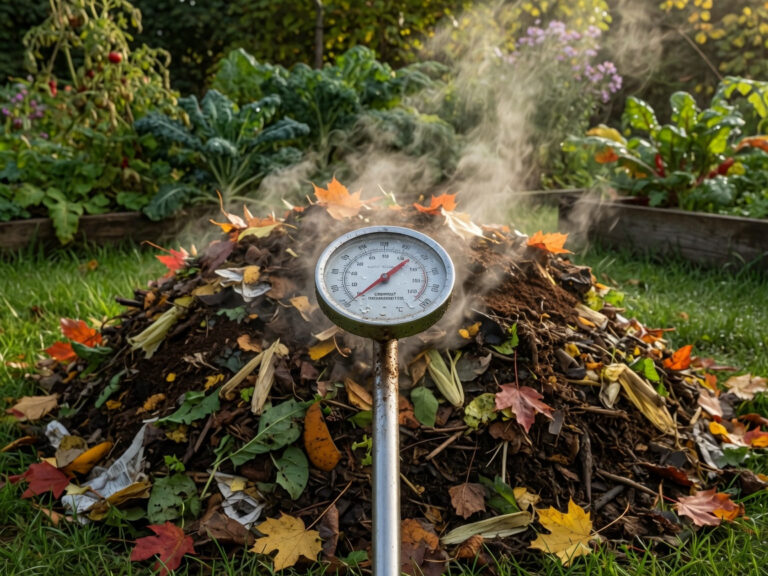
Shredding is consistently the most effective lever available to a home gardener. Practical trials from leading horticultural organisations show that shredding before piling reduces decomposition time by around 40–50%. If you’re keen to monitor conditions actively and get the most from your pile throughout the seasons, our overview of choosing the right thermometer for soil and compost covers the tools that help you track progress and act at the right moments.
How Can You Speed Up Leaf Mold Production?
Several practical steps consistently accelerate leaf mold breakdown without adding significant effort to the process.
- Shred the leaves before piling. This is the single most effective step and can cut decomposition time by 40–50%. Even a basic pass with a rotary mower over the leaf spread before gathering makes a very noticeable difference to the final timeline.
- Check moisture every four to six weeks. A pile that dries out essentially pauses decomposition until it is rewetted. Fungal decomposers need consistent moisture throughout the material. In dry summers, water an open bin whenever the material feels dusty rather than damp when squeezed.
- Add a thin layer of nitrogen. Grass clippings mixed through the leaf pile give fungi a nitrogen boost and accelerate early breakdown noticeably. Keep the ratio high in leaves — roughly 10 parts leaves to 1 part grass clippings — to avoid shifting from cold fungal decomposition toward a bacterial hot-composting process.
- Use black bin bags. The dark plastic absorbs heat and retains moisture — both beneficial for fungal activity throughout the year. For most home gardeners, this is the fastest and least space-intensive method available.
- Site bags and bins in a sheltered position. A spot against a fence, wall, or hedge, out of drying wind, maintains more consistent temperature and moisture. Hard frost temporarily slows decomposition, but typical UK winter temperatures rarely stop the process entirely.
How Do You Know When Your Leaf Mold Is Ready to Use?
Finished leaf mold is straightforward to recognise once you’ve seen it. All original leaf structure should be completely gone — no recognisable shapes, no crisp edges, no original colour remaining. What you have is a dark brown to near-black, crumbly material with an earthy, woodland smell. It holds together loosely when you squeeze a handful and feels slightly spongy or springy — not wet, not dry, but consistently moist and friable.
Partially broken-down leaf mold — where you can still see visible leaf fragments — is referred to as “young” or “rough” leaf mold. This is perfectly usable as a surface mulch, where it will continue to decompose in place and feed the soil over the coming months. It is not yet suitable for mixing into potting compost or using as a seed-starting medium, as the remaining leaf structure will interfere with fine root development and drainage.
A simple practical test: press the material through a standard garden sieve. If it passes cleanly, it is ready for all uses including potting mixes and seed trays. If it clogs the sieve with leaf fragments, apply it as a mulch and give the rest more time. There is no fixed deadline — check it when you think to, and use what is ready while leaving the remainder to mature further at its own pace.
How Do You Use Leaf Mold in Your Garden?
Leaf mold is a genuinely versatile soil amendment that has a useful role in almost every aspect of garden maintenance. Here are the most effective applications for home gardeners in 2026.
- As a mulch: Spread a 5–7cm layer around established plants and over bare soil between autumn and early spring. It suppresses annual weeds, retains moisture through summer, and slowly breaks down to feed soil organisms. Particularly effective around trees, shrubs, and perennial borders where soil disturbance is minimal.
- As a soil conditioner: Fork or lightly incorporate partially broken-down leaf mold into the top 10–15cm of a bed before planting. This simultaneously improves drainage in heavy soils and moisture retention in sandy soils — an outcome that reflects the unique physical structure of fungally decomposed material.
- As a potting mix ingredient: Fine, fully decomposed leaf mold makes an excellent substitute for peat in homemade growing mixes. A blend of one part leaf mold, one part garden compost, and one part coarse horticultural grit or perlite works reliably for most container plants, bedding, and hardy perennials.
- As a seed-starting medium: Fine leaf mold used alone, or mixed 50/50 with sharp sand, creates a low-nutrient, free-draining medium ideal for seeds that prefer lean conditions — including wildflowers, woodland plants, and many hardy annuals that resent rich compost at germination.
- As a compost heap ingredient: Shredded young leaf mold layered through an active compost heap adds fungal diversity and carbon-rich brown material simultaneously, helping to balance a heap that’s running too wet, too green, or too slow.
Can Leaf Mold Replace Peat Moss or Other Soil Amendments?
For most practical garden applications, yes. Leaf mold’s ability to improve soil structure and hold moisture closely mirrors what peat does in traditional growing mixes — but without the environmental cost. Peat extraction destroys irreplaceable wetland habitats and releases stored carbon; the gardening industry has been moving steadily away from it throughout the 2020s. Leaf mold, produced from a renewable annual resource that falls free in every garden, is one of the most practical and freely available alternatives for home gardeners in 2026.
The key distinction is nutrient content. Peat is essentially inert as a nutrient source. Leaf mold is low but not zero — it releases minerals slowly as decomposition continues. For a detailed look at how these amendments compare in practice, our article on choosing between peat and humus as soil amendments covers the practical trade-offs worth knowing before you make changes to your soil regime.
Where leaf mold clearly outperforms peat is in biological activity. Rather than acting as a sterile growing medium, leaf mold actively introduces and sustains beneficial fungi and supports the living soil ecology that keeps plants healthy over the long term. Soils that have become water-repellent or structurally degraded respond particularly well to regular leaf mold applications. Our guide to the causes and effects of hydrophobic soil explains exactly why organic matter is so central to solving this common garden problem.
What Mistakes Should You Avoid When Making Leaf Mold?
Leaf mold is a forgiving process, but a handful of common errors can significantly slow decomposition or reduce the quality of the finished material. Knowing what to avoid saves months of waiting for a substandard result.
- Never checking moisture. This is the most common mistake by some margin. A dry pile barely decomposes. Check monthly and water the pile if it feels dusty rather than damp — especially during dry spells from May through September when surface evaporation is high.
- Skipping shredding when time matters. Whole leaves mat into thick, nearly waterproof layers that deflect moisture and decompose very slowly. If you want usable leaf mold within a year rather than two, shredding before piling is non-negotiable.
- Including visibly diseased leaves. Cold fungal decomposition doesn’t reach the temperatures needed to kill plant pathogens. Leaves showing obvious rust, blight, or severe mildew are better sent to local authority green waste collection, which uses high-temperature industrial composting capable of destroying pathogens.
- Making too small a pile. A pile smaller than roughly 1 cubic metre loses moisture too quickly and doesn’t build sufficient biological mass to decompose efficiently. More leaves means faster breakdown and a better-quality product. Gather from neighbours, local parks, or roadside verges if your own garden doesn’t produce enough.
- Expecting leaf mold to act like compost. Leaf mold is a soil conditioner and mulching material, not a high-nutrient plant feed. Use it alongside compost or a balanced fertiliser for plant nutrition rather than as a sole fertility source. It does different work — and it does that work exceptionally well.

Frequently Asked Questions About Leaf Mold for Composting
Is leaf mold the same as compost?
No. Compost is made from a mixture of green and brown materials broken down primarily by bacteria in a hot, relatively fast process. Leaf mold uses only leaves and breaks them down through cold, slow, fungal activity over a longer period. The two products are distinct: leaf mold is lower in nutrients but superior for moisture retention, soil structure improvement, and the introduction of beneficial soil fungi. They work best used together rather than as direct substitutes for each other.
Can I use any type of leaves for leaf mold?
Most deciduous leaves produce excellent leaf mold. Oak, beech, hornbeam, and lime are the most reliable and widely available choices. Avoid walnut leaves (which contain juglone and can inhibit sensitive plants), very waxy evergreen leaves like holly or laurel (which decompose poorly in cold conditions), and conifer needles (which are very slow to break down and highly acidic). A mixed heap of common garden and hedgerow deciduous leaves will give perfectly good results without any precision sorting.
How do I speed up leaf mold decomposition?
Shred the leaves before piling — this single step can halve decomposition time by dramatically increasing the surface area available to fungi. Beyond that, keep the pile consistently moist, add a small amount of grass clippings as a nitrogen source, and use black bin bags to retain both heat and moisture. Combining all these approaches consistently takes breakdown from 18–24 months down to 6–12 months.
Can leaf mold replace garden compost?
Not as a direct nutrient source. Compost provides more plant-available nutrients and a broad range of organic matter; leaf mold excels at moisture retention, soil structure improvement, and enriching biological activity through fungal life. The most effective approach is to use both together: compost to feed plants and build fertility, leaf mold to improve physical structure and sustain soil biology. Together they create growing conditions that are consistently better than either amendment provides alone.
How much leaf mold should I apply to my garden?
As a mulch, apply a 5–7cm layer over bare soil or around established plants. As a dug-in soil conditioner, apply 5–10cm to the surface and incorporate into the top 15cm of a bed before planting. In homemade potting mixes, leaf mold typically makes up 20–40% of the total volume. You are very unlikely to over-apply it — the more you can produce and use over time, the better your soil will become.
Does leaf mold attract pests?
Leaf mold primarily attracts beneficial soil organisms — earthworms, ground beetles, and fungi — rather than pest species. Slugs and snails may shelter in moist organic mulches, so avoid applying thick layers of partially broken-down leaf mold directly against plant stems and crowns. Keep mulch a few centimetres clear of stems, and use fine, fully decomposed leaf mold in areas where slugs are a particular concern during the growing season.
Is leaf mold suitable for all types of plants?
Leaf mold benefits the vast majority of garden plants, and is especially valuable for woodland plants, shrubs, trees, perennials, and vegetables that thrive in humus-rich, moisture-retentive conditions. Acid-loving plants such as rhododendrons, azaleas, and blueberries particularly appreciate leaf mold made predominantly from oak leaves, which produces a slightly more acidic end product. Succulents, cacti, and other plants requiring very free-draining, lean conditions benefit less from leaf mold as a dug-in amendment, though it can be used sparingly as a surface mulch kept well clear of stems and rosettes.
Start Your Leaf Mold Pile This Autumn — Your Soil Will Thank You
Leaf mold is one of the simplest, most cost-effective improvements you can make to your garden soil. Every autumn, most gardens produce more than enough raw material. The process demands almost nothing from you — gather the leaves, keep them moist, and wait. By next autumn, you will have a supply of dark, crumbly, earthy material that genuinely transforms soil structure, moisture retention, and biological activity wherever you apply it.
Start this season: set up a simple wire mesh bin or fill a couple of black bags, shred the leaves if you have a mower handy, water them down, and tuck them somewhere sheltered. Check them in spring to see the process underway. In 6–18 months, you will have something that rivals any bought soil conditioner on the market — made entirely from material that would otherwise go to waste.
For gardeners looking to build soil health comprehensively through organic methods, leaf mold works best alongside good compost, active soil biology, and targeted organic amendments. If water-repellent or structurally poor soil is a challenge in your garden, our article on organic solutions for hydrophobic soil covers complementary techniques that pair particularly well with regular leaf mold use throughout the year.