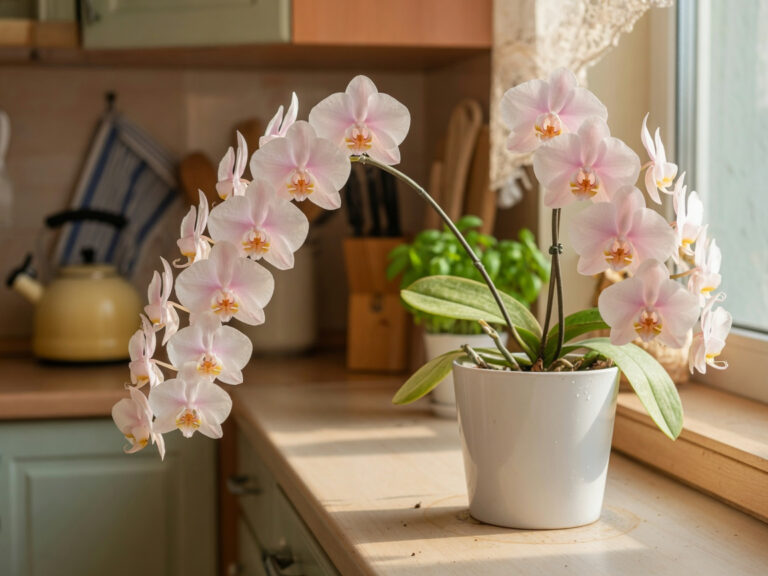

Bare-rooted orchid growing means cultivating your plants without any pot or traditional growing medium — and in 2026, it’s one of the most creative and rewarding approaches available to home orchid growers. By mimicking the natural habitat of epiphytic orchids, this method improves root health, unlocks a range of stunning display options, and cuts down on the plastic pots and disposable bark mixes that conventional orchid care demands.
Some of the links in this article may be affiliate links. If you make a purchase through these links, we may earn a small commission at no extra cost to you. Thank you.
Whether you’re drawn to the simplicity of the water culture method or something more ambitious like mounting your orchids on living trees or driftwood, this guide covers every option — along with clear care guidance and answers to the questions growers ask most.
Key Takeaways
- Most common home orchids — including Phalaenopsis, Cattleyas, and Vandas — thrive without any pot.
- The water culture method is the easiest starting point and works especially well in dry climates.
- Creative setups — from cork bark mounts to living tree displays — closely mirror how these plants grow in the wild.
- Bare-rooted orchids need more frequent watering than potted ones, but reward you with better visibility of root health and fewer rot problems.
What Is Bare-Rooted Orchid Growing — and Why Is It Worth Trying?
Bare-rooted orchid growing is exactly what it sounds like: growing orchids with their roots fully exposed, unsupported by potting mix, bark chips, or any other growing medium. The plant supports itself, absorbs moisture from the air and from regular watering, and behaves much as it would in its native tropical or subtropical habitat.
Around 75% of all orchid species are epiphytic — meaning they naturally grow on tree surfaces, rock faces, and branch crevices rather than in soil. In the wild, their roots are never buried. They cling to bark, dry quickly after rain, and are continuously bathed in moving air. When you grow an orchid in a conventional pot, you’re replicating this environment imperfectly at best. Bare-rooted culture gets considerably closer to the real thing.
The practical benefits are tangible. Because roots are never sitting in damp media, the risk of root rot and fungal infection drops sharply. You can see every root at a glance, making health checks quick and problems easy to catch early. And freed from the visual clutter of a pot, orchids become architectural features — something to display creatively rather than just maintain.
The main trade-off is watering frequency. Without a medium to hold moisture, bare-rooted orchids need water more often. For most growers, this becomes a comfortable routine within a week or two rather than a burden.
Which Orchid Species Are Best Suited to Bare-Rooted Growing?
The first thing to understand is that not all orchids can grow without a pot — but the majority of species commonly kept at home can. The key is knowing whether your orchid is epiphytic, lithophytic, or terrestrial.
Epiphytic orchids are the ideal candidates. Phalaenopsis (moth orchids), Cattleyas, and Vandas all fall into this group. Their thick roots are wrapped in a spongy layer called velamen that absorbs water rapidly and dries quickly — exactly the behaviour needed for open-air culture. Phalaenopsis are the most widely grown home orchid and adapt well to several bare-rooted methods. Vandas, with their especially vigorous root systems, positively thrive when given free-hanging conditions with generous airflow.
Lithophytic orchids go a step further — they grow directly on bare rock and stone in the wild. Genera such as Bifrenaria and Laelia belong here and can be mounted on flat stone slabs, slate, or decorative rock with beautiful results. If you’re new to growing orchids without soil, getting a clear picture of how orchid air roots actually function gives you the essential context for why these root systems perform so well in open-air settings.
Terrestrial orchids — including many native European and British wild orchid species — grow in soil by nature and are not suited to bare-rooted culture. Aqueous orchids, which live submerged in water in their natural environments, are equally unsuitable for standard bare-rooted methods.
How Does the Water Culture Method Work?
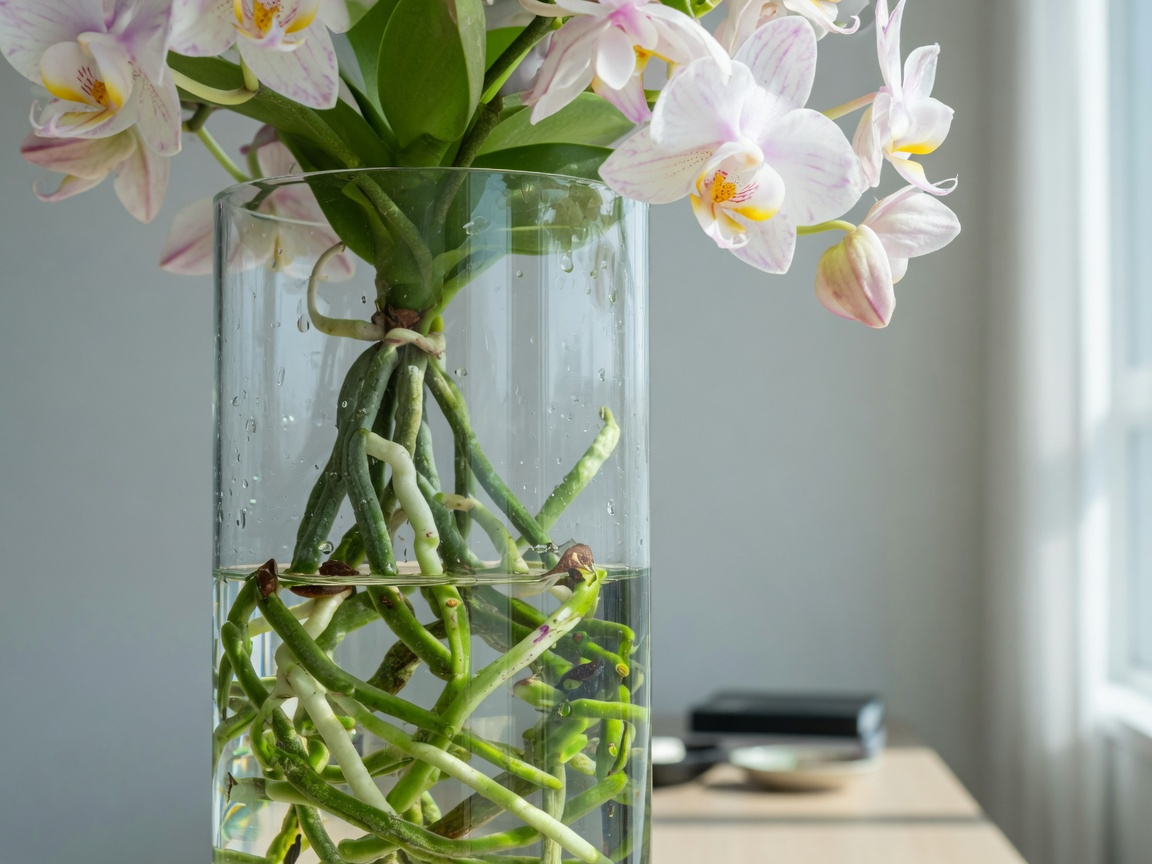
The water culture method is the most popular entry point for bare-rooted orchid growing, and for good reason: it requires minimal equipment, suits a wide range of growing environments, and makes root health visually obvious at a glance. It works particularly well for Phalaenopsis and is an excellent choice for dry homes or climates where ambient humidity tends to be low.
Here’s how to set it up from scratch:
- Choose a tall, clear container without drainage holes. Glass vessels work best — the transparency lets you monitor root colour and water level without disturbing the plant.
- Clean the roots thoroughly. Remove any existing bark, moss, or growing medium by gently rinsing under lukewarm water until roots are completely clean and separate.
- Position the plant carefully. Rest the orchid so its roots sit in the base of the container. The crown — the growing centre where leaves emerge — must remain completely above the waterline at all times.
- Add water and soak. Fill the container to just below the crown, let the roots soak for 15–20 minutes, then tip to drain completely. Never leave the roots permanently submerged.
- Repeat on a schedule. In dry conditions, soak daily. In humid rooms or during cooler months, every 2–3 days is typically sufficient. Bright green roots still hold moisture; silvery-white roots are ready for their next soak.
- Change the water every 1–2 weeks. Rinse the container thoroughly before refilling to prevent bacterial build-up. Consistent water hygiene makes a significant difference to long-term root health.
If you want to build strong, resilient roots from the very beginning of your bare-rooted journey, the detailed guidance on promoting orchid root growth covers the essential techniques and conditions worth establishing before you transition your first plant.
What Are the Best Creative Mounting Setups for Bare-Rooted Orchids?
One of the greatest pleasures of bare-rooted orchid culture is the freedom to display your plants in ways no conventional pot allows. Here are the main mounting options, from the most approachable through to the most impressive.
Cork Bark and Driftwood Mounts
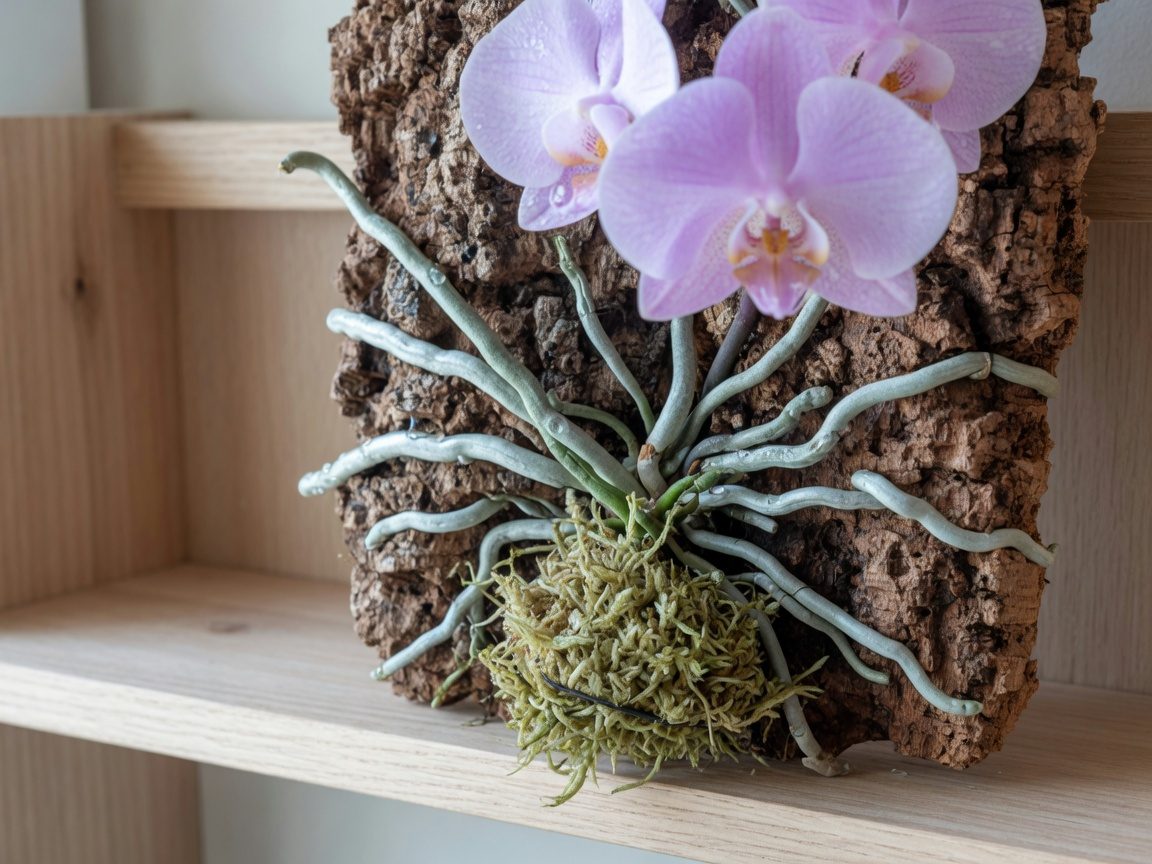
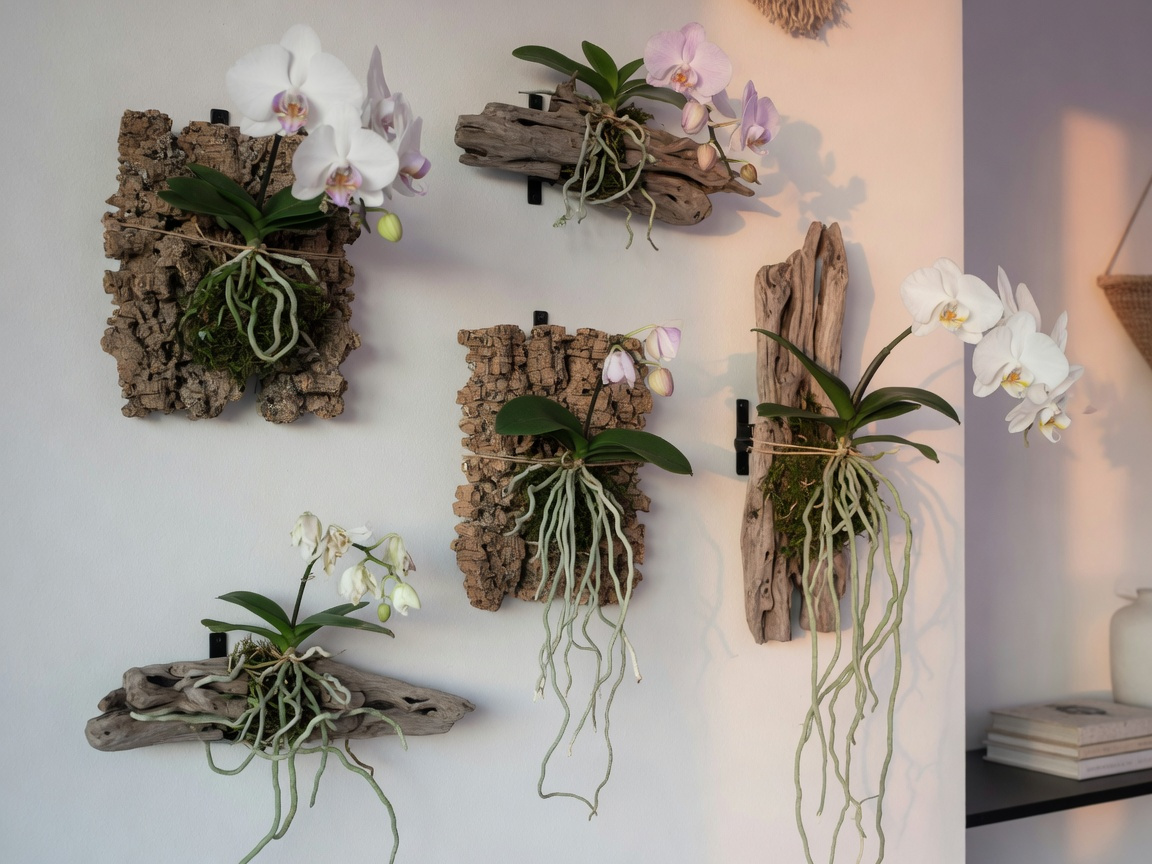
Cork bark is the gold standard for orchid mounting. It’s lightweight, naturally rot-resistant, and has a porous, rough-textured surface that orchid roots grip and colonise readily. Driftwood pieces offer a more sculptural look and work especially well in living rooms and conservatories. To mount, position the orchid’s roots against the surface, place a small pad of sphagnum moss between roots and mount for initial moisture retention, then secure with soft plant ties or natural twine. Once roots begin to anchor — usually within 8–12 weeks — they hold themselves without any further support. Mounts can be displayed flat on a wall, propped on a shelf, or hung vertically.
Rock and Stone Mounts
Lithophytic species like Laelia and Bifrenaria can be secured directly to flat stone slabs, slate tiles, or large decorative pebbles. This suits both indoor displays and sheltered outdoor rock gardens. The thermal mass of the stone buffers temperature fluctuations and retains a small amount of warmth and moisture through cooler evenings. Use a thin moss pad between roots and stone during initial establishment to protect against surface abrasion while roots develop their grip.
Living Tree Mounting
In warmer gardens or sheltered outdoor spaces, mounting orchids on living trees creates a naturalistic display that can be genuinely breathtaking. Trees with rough, moisture-retentive bark — oak, cherry, and fig are popular choices — provide a microclimate that supports root development through natural humidity and organic surface texture. Vandas, which prefer high light and vigorous open-air conditions, excel in this setting. Secure plants with soft ties initially; once roots bond with the bark, the tree itself takes over as the anchor.
Open Baskets and Hanging Displays
Open-slatted wooden or rattan baskets allow roots to trail freely through the gaps, creating an airy, naturalistic aesthetic that works beautifully hanging near bright windows indoors or suspended under greenhouse eaves. Phalaenopsis orchids can also be mounted upside down on wall plaques — a technique that keeps the crown completely dry and protected while roots hang freely and visibly below.
How Do You Prevent Crown Rot in Bare-Rooted Phalaenopsis?
Crown rot is the most common hazard with bare-rooted Phalaenopsis, and it’s almost entirely preventable once you understand what causes it. The crown — the central meristem where leaves and flower spikes emerge — cannot tolerate standing water. When moisture collects in the crown and isn’t able to evaporate quickly, bacterial or fungal infection follows rapidly.
The most reliable prevention technique is orientation. Position your Phalaenopsis at a forward tilt, or mount it fully inverted on a wall plaque, so any water that reaches the crown simply runs away rather than pooling. This is why upside-down Phalaenopsis mounts have become so widely adopted — the plant looks dramatic, and the growing point stays reliably dry.
When watering, direct water at the roots only. If water does reach the crown, blot immediately with a soft cloth and ensure good air movement around the plant to dry it quickly. A small fan on a low setting nearby helps considerably during humid spells. If you spot early rot developing at the crown or lower stem, trim the affected tissue with a sterile blade and treat the wound with cinnamon powder, which acts as a natural antifungal. For a complete treatment guide, the detailed resource on preventing and treating orchid stem rot covers every stage of the process.
What Media Options Work Best for Bare-Rooted Orchids in Dry Climates?
In low-humidity environments, a fully bare-rooted approach can leave roots drying out too quickly between watering sessions. A hybrid approach — using a small amount of moisture-retaining material alongside the bare-rooted method — handles this well without sacrificing the key benefits of open-air root culture.
| Media Option | Best Application | Moisture Retention | Airflow Rating |
|---|---|---|---|
| Sphagnum Moss | Root wrapping, mounting pad | High (up to 20× its weight) | Moderate |
| LECA (Lightweight Expanded Clay) | Semi-hydro cache pots | Moderate | Good |
| Bark Chips | Open baskets, loose containers | Low to Moderate | Excellent |
| Cork Bark (bare mount) | Wall and hanging displays | Low | Excellent |
Sphagnum moss is the go-to choice for most dry-climate growers. It can hold up to 20 times its own weight in water, releasing moisture gradually to roots over an extended period. A small pad wrapped around the root base when mounting provides a meaningful moisture buffer between watering sessions. Crucially, allow the moss to dry partially — but not completely — before you water again. Permanently damp moss leads to the very root rot you’re working to avoid.
LECA (lightweight expanded clay aggregate) suits a semi-hydroponic variation of bare-rooted culture. The clay balls sit in a cache pot with a small water reservoir at the base. Roots grow through the LECA freely and draw moisture up as needed. The method keeps roots airy while providing consistent, controlled hydration. If you’re weighing LECA against other growing media, a hands-on comparison of LECA versus Seramis for orchid growing provides real-world experiment results to guide your decision.
How Do You Care for Bare-Rooted Orchids Growing Indoors?
Indoor bare-rooted orchids are easier to monitor than potted plants — there’s nowhere for problems to hide. The key variables to manage are light, humidity, watering frequency, airflow, and feeding.
Light. Most epiphytic orchids need bright, indirect light. A position within 1–2 metres of an east- or south-facing window works well for Phalaenopsis and Cattleyas. Vandas prefer stronger light and benefit from a brighter spot or supplemental grow lighting during short winter days in 2026’s darker months.
Humidity. Aim for 50–70% relative humidity. Grouping several plants together raises local humidity naturally. A pebble tray filled with water placed beneath the display is a simple, low-effort solution that many indoor growers rely on year-round. Avoid positioning orchids near radiators, wood burners, or air conditioning vents — all of which create dry, still air conditions that bare-rooted plants find stressful.
Watering. Read the root colour every time you check your plant: silvery-white roots are dry and ready for water; bright green roots still hold moisture. Only water when roots are silvery-white. This simple indicator is more reliable than any fixed schedule and prevents both overwatering and underwatering.
Airflow. Gentle air movement prevents fungal and bacterial issues. A light background airflow from an open window or a small desk fan on its lowest setting is beneficial. Still, stagnant air around bare-rooted plants is a genuine risk factor — particularly in winter when windows stay closed.
Feeding. Fertilise at half the recommended concentration every 2–4 weeks during active growth. Because there’s no growing medium to buffer nutrients, feeding little and often is far safer than applying full-strength doses. For anyone wanting to push their orchid toward producing multiple flower spikes, the detailed guide to the essential factors behind multiple orchid spikes is a genuinely useful companion read alongside these care steps.
What Common Mistakes Should You Avoid with Bare-Rooted Orchids?
A few predictable pitfalls catch out even experienced growers when they first transition to bare-rooted methods. Knowing them in advance saves a great deal of frustration.
- Leaving water culture orchids permanently submerged. The water culture method requires a soak-and-drain cycle, not continuous immersion. Roots permanently underwater rot quickly. Always drain fully after each soak.
- Skipping the transition period. Moving a long-potted orchid directly to a bare-rooted setup can shock the plant, whose roots are accustomed to continuous moisture from the medium. Remove the existing medium gradually over several weeks rather than all at once.
- Using tap water straight from the tap. Fluoride and chlorine in mains water can damage orchid roots over time, particularly in water culture where roots are in direct contact. Let tap water stand for 24 hours before use, or switch to filtered water or collected rainwater.
- Mounting Phalaenopsis upright without crown protection. Phalaenopsis mounted right-side-up with no crown drainage are prime candidates for crown rot. Always tilt the plant forward or orient it inverted on the mount.
- Neglecting regular root inspections. The openness of bare-rooted culture is one of its greatest practical advantages — make use of it. Inspect roots weekly. If you’re unsure what healthy versus unhealthy roots look like, the in-depth guide to when to trim orchid roots and when to leave them alone provides clear visual guidance for making the right call.
Frequently Asked Questions About Bare-Rooted Orchid Growing
Can all orchids be grown bare-rooted?
Most common home orchids can, but not all. Epiphytic species — Phalaenopsis, Cattleyas, Vandas, and Dendrobiums — are well suited to pot-free culture because their root systems are adapted to open-air conditions. Lithophytic orchids like Laelia and Bifrenaria can be mounted on stone or rock. Terrestrial orchids, which naturally grow in soil, need ground planting and are not candidates for bare-rooted methods. Aqueous orchids require permanent immersion and are similarly unsuitable.
How often should I water a bare-rooted orchid?
Frequency depends on your climate, the specific method you’re using, and the season. In the water culture method, a daily or every-other-day soak-and-drain cycle is standard. For bark or driftwood mounts in a typical home, once or twice daily in summer and every 2–3 days during cooler months is typical. The root colour is your most reliable guide: silvery-white means dry and ready to water; bright green means moisture is still present. Never water green roots.
What’s the best mounting material for beginners?
Cork bark is the most forgiving and widely available mounting material. It’s naturally resistant to rot, has the right texture for roots to grip, and is light enough to hang easily. For a first mount, choose a piece large enough to give roots room to spread over 2–3 years. Driftwood is a good second choice and gives displays a more sculptural, decorative character. Avoid smooth-surfaced materials like painted wood or plastic — orchid roots struggle to anchor on these and rarely establish well.
What should I do if my bare-rooted orchid is struggling?
Start with a thorough root inspection. Cut back any mushy or blackened roots to healthy tissue with a sterile blade and treat the wounds with cinnamon powder. If the plant has lost most or all of its roots, the step-by-step approach in the guide to reviving a rootless orchid walks through a proven sphagnum moss recovery method that encourages new root development from the base of the plant. Move the plant to a spot with slightly higher humidity and reduce watering frequency temporarily while new roots emerge and establish.
Can I fertilise bare-rooted orchids?
Yes — and it’s especially important for water culture orchids, which have no growing medium to buffer or hold residual nutrients. Use a balanced orchid fertiliser at half the recommended strength every 2–4 weeks during active growth. For water culture setups, add fertiliser directly to the soaking water. Flush with plain water every third or fourth watering cycle to prevent salt accumulation on the root surfaces over time.
Is bare-rooted growing suitable for complete beginners?
The water culture method is genuinely beginner-friendly. The setup takes under ten minutes, the ongoing routine is simple, and a clear container makes monitoring straightforward. The single most important habit to build is consistency — watering on a regular schedule and keeping the crown dry. Bark mounting takes slightly more preparation but is still accessible with good guidance. Most beginners find the transition less daunting than they expected, and the visible improvement in root health tends to make the additional watering effort feel entirely worthwhile.
Your Next Step: Get Started This Week
Bare-rooted orchid growing opens up creative display possibilities that a conventional pot simply can’t match — and in 2026, both the methods and the materials available make it easier than ever to try. Whether you start with a glass vessel and a spare Phalaenopsis on the kitchen windowsill or go straight to building a driftwood wall mount, you’re moving your plant closer to the conditions it evolved for.
The most important first step is the simplest: pick one method, commit to it for four to six weeks, and observe closely. Watch the root colour, adjust your watering frequency, and let the plant tell you what it needs. Most growers who make the switch don’t look back.
As you develop your bare-rooted practice, the comprehensive guidance in the complete overview of orchid care covering repotting, feeding, and watering during blooming provides a strong practical foundation for the key care decisions you’ll encounter throughout the year.